Showing posts with label soup. Show all posts

Friday, March 4, 2011

Soup of Leftovers and Throwing Stuff in the Oven

Let’s talk about how meals happen. Because we are sitting down to a nice chat, and you’re the most indulgent listener ever, just dying to hear whatever half-baked spiel that crawls out of my mouth. You see, dear reader, for the most part making food happens out of desperation for me. I am horrible at planning ahead, and when I’m busy as I have been recently, I do the cognitive equivalent of grabbing whatever is within reach. Or I literally grab the nearest things in the kitchen. At such times, some basic forms of cookery are necessary frames to keep it all from getting too unmanageable both mentally and logistically. The past two days indicate that apparently I have at least two such shortcuts on hand: make soup of leftovers, or throw things in the oven. Probably I don’t have them on hand or in head at all, but somehow, thankfully, they happened.


Soup is probably the most well-trod way of using up leftovers. A lot of various things suddenly become commensurate when thrown in a pot of water or stock. I made soup of leftovers because I saw refried beans, fried kale, cooked ground beef, half an onion, a tortilla, and some mushrooms in the fridge, and I thought “soup!” And of course because it’s me, before any water came into the picture I browned onions, mushrooms, and garlic in some oil. And there was quite a bit of chili powder. And some possibly ill-advised cumin. (I couldn’t help but think of the overpowering odor of Rufus’s chili.) I know, these details outside of a recipe have you rapt, don’t they? Little did you know I’m trying to snuff you out in a blizzard of Irrelevant Facts.

A tangent: I actually have no clue what I’m doing when it comes to seasonings. (Or, well, anything really, but seasonings especially.) I am either falling into strange habits, experimenting blindly, or being minimalist (salt, pepper). The thing is, I only understand how flavors go with other flavors in the negative. If I’m putting things together I’m thinking sure, I guess this might taste good together, maybe. But suggest to me a combination and often you’ll get a response of “ew,” or an extremely ill-masked dubious look. I apologize for this particular knee-jerk of mine.


Anyway, throwing stuff in the oven seems initially like a wonderfully lazy option. But I always end up babying the stuff. Tonight the stuff was pork chops, onion, red pepper, and mushrooms. Pork chops cook quickly, apparently, because they were done in about half an hour, at which point I thought nooo they must be browned! and turned the oven to broil for five minutes. Then I put them on a plate, and continued to bake the soupy vegetables. Of course, I may as well have put them in a pan on the stove for all the stirring I did. Must’ve opened the oven five or six times. The problem was that the vegetables released a lot of water, thus stewing the pork chops rather than roasting them, and thus no sear. Maybe pork chops roasted with vegetables is just not to be. The only viable method I can think of is to suspend the poor things on a wire rack above the roasting vegetables, and basting them in the vegetable juice a few times. But that just sounds wayyy to involved. Although it can’t really be more involved than what I did this time.


Sorry, no recipe. Come on, you don’t really want a recipe for Soupy, Overcooked Pork Chops With Roasted Vegetable Topping, do you? There was once a time when this blog was about perfecting techniques and recipes. It has since devolved into me babbling about whatever the hell I feel like, sometimes connecting it to what I happened to have cooked recently. The defining change is that intentionality has left. I no longer cook things to post them on my blog. I cook what I cook, and sometimes take photos to keep the possibility of blogging about it open. In this case I forgot to take a photo of the roasted things, and instead you just get these photos of the uncooked ingredients arranged in the pan to go in the oven.


Wednesday, February 16, 2011

Pantry Cleanse II: Quinoa and Kidney Beans

There are two things lurking in my pantry that have become staples in the last two weeks. I always cooked and ate them separately--quinoa as a kind of hot grain salad, and kidney beans as a thick soup. Today I decided to make a meal of combining the two.

This being a "pantry cleanse" (a term I've lifted from "life, in recipes"), all of the ingredients are incidental. Each has a particular history of how it ended up in the kitchen. Because my father has a tendency to buy food as if we are preparing for the end times, we have an entire case of canned kidney beans, and a giant bag of quinoa. There are those things that I habitually buy and see as necessities: onions, cooking oil, salt, chili powder. I bought the green onions because they were on sale and I thought they might encourage me to improvise. My brother and I got a yellow beet and carrots for a salad some time ago. I don’t remember why we had mushrooms and jalapenos--for some other meal. Inexplicably we have what to me is an enormous quantity of saffron. I really don’t know what to do with it. I put it in all sorts of things, thinking that I’ll taste it, but I don’t. Its subtle flavor eludes me. In imitation of some kind of aromatic rice dish, I used it in the quinoa, along with some cloves.

Incidental food is a topic that I have talked too much about, but I think insufficiently. Sure, there are recipes, like this one, that come about incidentally. But what I want to talk about is how it’s a deceiving accident of idiom that one makes food. What I want to say amounts, basically, to an “in Soviet Russia” joke: food makes you! There are several reasons for this. As much as the ingredient lists of some recipes would have us believe supermarkets are infinities of choice, there are in fact items that are not available. Foods are varying levels of affordable in different places. We are habituated to certain kinds of foods and preparation methods. And most importantly, food is woven into our social lives, our families, and our psychology. Maybe your mother tries to dictate what you eat. You may not necessary follow all or even any of her commands, but nonetheless your gustatory life becomes defined by them, by her. Maybe you live with your grandmother, and she only has certain scare items in the kitchen. Maybe your crazy landlord lives and sleeps in the kitchen, and you want to limit your time there as much as possible. Maybe you live at home with your father who impulsively buys an assortment of food that you feel compelled to use before it perishes. And maybe you’re a cheapskate and want to eat as much of the odd items laying around the kitchen as possible, buying only very little.

Nigella Lawson talks about culinary agency with a turn of phrase that I like, “greedy opportunism.” Of course there’s more than a little contrivance in her usage. Greedy opportunism is the process of gadding about in her shining kitchen picking out gourmet goodies that just happened to find their way there, and relishing some new use for them. It is as if she has an infestation of pantry-stocking gremlins. But while it is a class-charged way to frame her show, it’s also one way that improvisation in cooking happens: things you don’t necessarily have a planned use for will end up in your kitchen; use them somehow. At least half of what I cook is through greedy opportunism. Although I must admit that only rarely is it greedy.

Beans
2 12oz cans kidney beans
2/3 cup water
1 onion
4 mushrooms
1/2 carrot
1/4 yellow beet
1 clove garlic
1/2 jalapeno
1 tablespoon cooking oil
1/2 teaspoon chili powder
1/2 teaspoon salt

Chop onion 1cm square. Cut mushrooms in half and then slice finely. Julienne carrot into 1/2 inch long pieces. Chop beet, garlic, and jalapeno half finely. Fry all vegetables in cooking oil in a large saucepan on medium heat. Add salt and chili powder. Sautee for about twenty minutes, stirring every few minutes. Don't stir more often because the mushrooms won't brown. Stir in kidney beans and water. Bring to a boil and then remove from heat.

Please, please give me something
better to do with saffron.
Quinoa
1 cup quinoa
2 cups water
1/4 lemon
1/3 cup chopped green onions
1/4 teaspoon saffron threads
1/2 teaspoon salt
1/4 teaspoon powdered cloves or 4 whole cloves

Combine quinoa and water in a medium pot and and bring to a boil, covered. Remove from heat and add lemon quarter, green onions, saffron threads, salt, and cloves. Cover and simmer on medium-low heat until all the quinoa has absorbed all the water. Remove from heat, add salt, and mix to disperse seasonings.

Thursday, January 27, 2011

Biscuits & Kidney Beans

Yesterday, in an attempt to entertain myself by imposing arbitrary lifestyle contraints, I decided not to use my computer. Yes, it's true, I composed this with pen and paper. Laugh it up at my affectation. The point is that instead of looking to the internet for proportions of flour, butter, and milk, I followed The Joy of Cooking (1972 edition) recipe for biscuits. It calls for kneading the dough "a scant 1/2 minute." (I do love this book's diction. It has so many instructions it creates its own semantic universe in which every term has precise meaning.) I had never realized kneading might be an important part of making biscuits; I thought one was supposed to handle the dough as little as possible. It turns out kneading is how they're made flaky.


I may have rolled the dough too thin. The recipe says to roll "until the dough has the desired thickness." That was a quarter of an inch in my case. They only rose to about half an inch. My brother commented that they looked English. They do look more like I imagine scones should look than they do biscuits. But they're too thin to be cut in half. So they aren't even scones really. But I like them. There's something really nice about the way they get stale. They get stiff and just a bit chewy. In this stale state they're perfectly suited to eating with hot liquids such as tea or soup. And they're the sort of thing you would put in your knapsack before setting off into the forest.


I made these to go with a pot of kidney beans seasoned with sambar powder. This came about because I couldn't find the cayenne chili powder I wanted to use. (The sambar powder consists mostly of chilis.) I'm not sure it's the greatest combination, but it was an improvement over kidney beans without the seasoning.

2 cans cooked kidney beans
1/2 cup water
2 tablespoons cooking oil
1 large onion
2 cloves garlic
3 teaspoons sambar powder
1 teaspoon dried oregano
salt to taste

Chop onion into medium pieces roughly 1/2in square. Chop garlic as finely as possible. In a medium pot on medium-low heat, fry garlic in oil. When it is just browning, add sambar powder, dried oregano, and onions. Fry onion until well softened, maybe 20 minutes, stirring and scraping bottom every minute or two with a rubber spatula. Add kidney beans and water. Simmer for ten minutes and then serve.

Wednesday, December 8, 2010

Chicken Soup

Simmering stock from chicken carcass
and vegetable scraps that I've frozen
 over the past few weeks.
Making chicken soup from scratch is a long string of delayed gratification. It’s not just that there’s a lot of waiting, but also that there are so many stages of the process. This accounts, I think, for my enthusiasm for making soup. There are days of anticipation. First I have to salt the chicken, leaving the chicken to soak up the salt overnight. The next day I roast it, and if I’m feeling particularly impatient and productive, I begin simmering the stock in the same day. More likely it won’t be until the carcass is mostly picked off a day or two after I roast it that the stock is begun. Once the stock has finished simmering (usually I leave it overnight), finally soup can begin.

The above is a simplification of what’s involved of course. Before roasting the chicken really should be dried out a bit in the interest of crispy skin, although honestly I don’t often bother. Before making stock the carcass should be stripped of most of the good meat (but not all), which is at once satisfying and daunting (despite the fact that it takes less than ten minutes). After the carcass has simmered with flavoring vegetables, the stock must be strained and possibly skimmed. And of course the contents of the soup itself must be cooked and seasoned.
The stock is somewhat cloudy
because I misguidedly used
potato skins.

This time it was rice, carrots, and leeks. Planning and preparing the ingredients is for me a form of utopianism: “yes, this will be perfect in the soup.” And the soup I imagine will save any lack of care, binding everything together into a hot selfsame liquid. To reverse the sense of a Woosterism, once it’s in the soup, it’ll be spiffing.

At the end of all this the soup is--well it’s okay.


Saturday, October 3, 2009

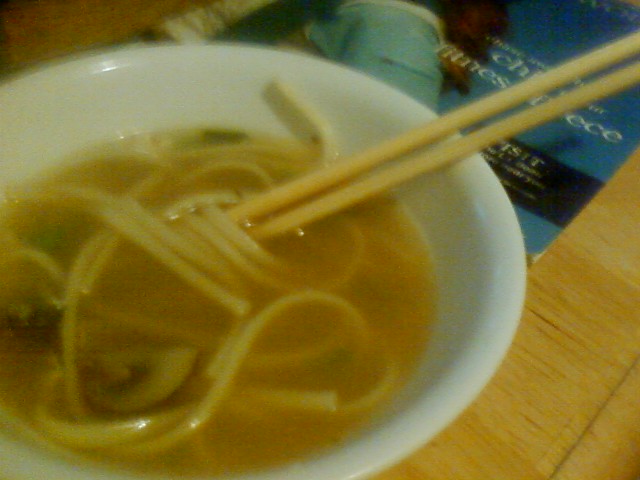
Fancy Ramen (actually Udon)

The bouillon I used isn't much of an improvement over the powdered broth in packets of ramen: still chock full of MSG.  You could use less nasty broth obviously--I'm planning on it next time.

~4 cups water
1/2 cube chicken bouillon
2 teaspoons tamari
1 small garlic clove
1 small (~2cm cube) piece fresh ginger
1/4 fresh jalapeno
1 mushroom
1 heaping tablespoon green onions
3oz udon
1 egg

Begin heating the water in a medium pot on high heat.  Chop the garlic, the quarter of a jalapeno, and the mushroom.  Cut off the skin of the piece of ginger.  Drop these into the pot, along with the bouillon and tamari.  When the water boils, add the dry udon.  Chop the green onions into pieces with larger diameter than depth.  Try a noodle every few minutes.  When they're almost done, crack the egg into the pot.  Crack two, if you like.  Scrape the bottom with a spoon or spatula to keep the egg from sticking.  Boil it for a little more than a minute, then turn off the heat, add the green onions, and serve.

Tuesday, September 29, 2009

Lentil Soup #41358


We can pretend that the sweetness of the sauteed onions is accentuated by the seemingly out of place nutmeg and cinnamon in this soup. Really, convince yourself. Or maybe the odor of the nutmeg will unexpectedly please you. Or maybe you don't care, and you will look at this recipe only for its proportions of water, lentils, and salt (the last of which isn't provided). Which is all you need anyway I'm sure.

1/2 pound lentils
one small onion
one or two cloves of garlic
one or two fresh chiles (something medium hot, like serrano)
one tomato (roma, but any kind will do)
2 tablespoons butter
2 tablespoons cooking oil
three teaspoons coriander powder
two teaspoons cumin powder
1/2 teaspoon cinnamon powder
a pinch of freshly shaved nutmeg
salt to taste (a guess: 3 teaspoons)

Put a medium pot on medium-low heat, pour in the cooking oil, and melt the butter in it. Meanwhile, chop the onion into 1cm square pieces or smaller, the garlic as finely as possible, and the chile(s) into lengthwise quarters and then fine slices. Transfer all three into the pot and spread evenly for frying. Make sure that the heat is low enough that it doesn't burn the onions. Add the coriander, cumin, cinnamon, and nutmeg. Slice the tomato into quarters and then fairly thin slices. Once the onions are translucent, soft, and somewhat sweet, add the lentils, the tomatoes, and roughly a quart of water or twice as high as the lentils in the bottom of the pot. Turn heat to medium-high until the water boils, and then turn back down to medium-low. Let it mildly boil until lentils expand to the top of the pot, then add more water to create your desired consistency (I like to keep at least a 1/2 inch of water above the mass of lentils). Add salt. Continue cooking on low heat until the lentils are soft. You may need to add more water.