Showing posts with label sauce. Show all posts

Wednesday, October 12, 2011

Sweet Potato Gnocchi

Let me tell you about everything I won't be telling you about in this post. I will not tell you about cinnamon bread pudding with lemon-whiskey sauce. I will not tell you about mushroom sugo, which is what I had planned on making for this post. I don't remember how exactly I landed at the recipe page, but for some reason I had to make it. Maybe it was because it's the opposite of the simple tomato-butter-onion equation. It has everything--mirepoix, wine, mushrooms, tomato sauce, beef broth. The expense of the ingredients I needed to buy to make it persuaded me to make something else. I have too much food at home, not too little, and the prospect of buying tons of ingredients to make something that only I was going to eat seemed a bit absurd. Of course, what I did make was as labor-intensive as the sugo was expensive.

There is something a bit creepy about how I find myself approaching this blog: I feel that I have to make something new and exciting to post about. I would say this is just out of desperation for content, but no, usually I have plenty of other things I could write about, but instead I feel I have to put effort into something new to have permission to write these blog posts. As if somehow the effort put into making the thing is readable in what I write about the thing. God forbid I be lazy--it would show!

So instead I am lazy in other ways. The sweet potato gnocchi (because I had two sweet potatoes on the counter) recipe I wanted to use, chosen because of its lack of egg or egg yolk, which I am told yields softer gnocchi, called for straining the fresh ricotta with a sieve and a piece of cheesecloth for two hours. Not having either of these things, nor wanting to take another two hours, I searched for a recipe without eggs that used unstrained ricotta. I found it, but the first recipe cut a corner that this second one didn't: microwaving the sweet potatoes instead of baking them. Which took about twelve minutes. I have to say, making gnocchi went surprisingly quickly.

To be honest I'm sick of brown-butter-sage-cream sauce, but for once it seemed like the best possible sauce for these gnocchi. Sage and sweet potato (or pumpkin) go very well together, and gnocchi are lovely drowned in dairy fat. Actually, now that I think about it maybe the high-priced, secretive bistro with their own garden down the road has the right idea with gnocchi: Serve them in a light, almost soupy sauce of herbs, butter, and sauteed vegetables. The problem with cream sauces is that they only amplify gnocchi's richness. Which would be wonderful if served with something else, (something stewed, perhaps, and not overly rich), but on its own its difficult to eat very much of.

The ricotta is supposed to give gnocchi a desirable texture (not gummy, but fluffy). That was what I was most excited about this recipe. I had always made potato gnocchi with potato, flour, and an egg. The egg is supposed to be the inferior but easier way to make gnocchi. I can’t remember why. Maybe the dough is more difficult to handle without the egg?

I suppose I could do the whole “I will describe what I made in sensuous language” thing. They're orange pillows of delight--something like that. They were yummy, but I think maybe gnocchi should not be served alone. Or... Well, the most easily palatable way I've ever had them, actually, was with the tomato-butter-onion sauce. The gnocchi were not that great (dry packaged), but the sauce complimented them rather than doubled them. However, I'm not sure how well sweet potatoes would go with tomato sauce. Sweet with sweet? What would be the ideal sauce for sweet potato gnocchi?

They taste a bit like pumpkin pie (it must be the nutmeg), with sage. Maybe sage doesn't go with pumpkin and sweet potato after all. Who knows. What goes with anything else anyway?


Monday, September 26, 2011

Potato Gnocchi with Tomato Sauce with Onion and Butter

I made gnocchi with Marcella Hazan's tomato Sauce with onion and butter.

It has become habit to say in these posts what I didn't do. I didn't make gnocchi. I bought dry, packaged gnocchi from the store and boiled them. Marcella Hazan's recipe calls for either fresh tomatoes or whole canned tomatoes, cut up, in their juice. I apparently bought the wrong kind of canned tomatoes, because they didn't have juice. They had tomato puree. I do not understand why this is a product. I did not chop up the tomatoes very small (although Hazan does not specify how small they should be chopped), and I only remembered to chop them at all halfway through simmering. I sliced them with a chef knife while they were in the saucepan, holding them in place with a large fork. In any case, you can decide if that matters. It was still tomatoes simmered with butter and an onion.

It was good. Sniffing the air, my brother asked what was in it. Butter. Lots of it. Actually less than was called for: The recipe called for two cups of tomatoes, and five tablespoons of butter. I used the whole can of tomatoes, which was about three cups. I didn't have enough butter to account for this change. I only had six tablespoons.

Hazan says it's "an unsurpassed sauce for Potato Gnocchi." I was excited about this. I definitely wanted to make gnocchi with this sauce. Making gnocchi from scratch is a pain. Preserved, store-bought gnocchi has a strange after-taste. I forgot to get gnocchi or ingredients to make gnocchi when I was in the store buying ingredients for the sauce. I made the sauce anyway, planning to get gnocchi from the store later. I did, but only after I ate the sauce with Costco tri-color bow-tie pasta because I was hungry and because I did not have a car with which to go to the store to buy gnocchi. The sauce, covered in parmesan, was good. It was quite salty. Hazan suggests salting sauces beyond what tastes right on their own, because the sauce has to cover not very salty pasta (or gnocchi). This seems like good advice. What I am not convinced of is that this sauce is unsurpassed for gnocchi. Butter on gnocchi is good, and this has lots of butter. The sauce on its own is good. Was it perfect for the gnocchi? I don't know. I am used to just butter and parmesan, or just butter, or butter and cream. In fact eating these reminds me that when I was much younger my mother used to buy packaged gnocchi (the kind one refridgerates), and I loved to eat them with (salted) butter. Nothing but butter, I think.

Some other bloggers have raved about this sauce. One called it a revelation. It is good. It is elegant. It is edifying: One does not need tons of herbs, or any at all, to make good tomato sauce. One of my friends goes so far as to say herbs mess up tomato sauce, which I am hesitant to agree with. Herbs have their place. But perhaps, like Hazan says of garlic, they should be used with intention in particular circumstances, not by default.

Maybe next will be bolognese. I tried making pseudo-bolognese the other week. I used a great deal of red wine, which curdled the cream. At least I think it did. It was difficult to tell.

Monday, September 19, 2011

Pasta

Back in the day, we used to make fresh pasta. Making foods whose production was showy was a thing we did. Before I became a part of that adolescent social economy, they made crepes. Not only was making crepes a show, but it could be made into group activity. One might make the batter, another pour it, and the last, the one who got all the glory, babied and flipped them. This particular person liked to burn himself by using his fingers to flip the crepes. He (of course it would be he) was known back in those days as The Devil. God bless him. (No, really. His cooking sensibilities have definitely become a part of mine, and his enthusiasm and adventurousness were indispensable in such endeavors.)

The Devil and I made pasta a lot. We made it at both of our houses. We made it at gatherings. We even made pasta in Germany, where we convinced ourselves it was Spaetzel. We made it always in the same way (except in Germany, where we could not find semolina flour). I have no idea where we came upon this way of making it, and I don't remember ever reading a recipe. The Devil suggested it authoritatively, and off we went. At no point was there any textual reference, but now I will have to make one. This is what we did:

In a mixing bowl we put some semolina flour. We made a little crater in the flour into which we cracked as many eggs as were necessary to make the dough just cohere, a little olive oil, and a sprinkle of salt. We mixed this together, eventually using our hands to form the dough into a ball and knead it. We kneaded it quite a lot. It was as if we were making a material for construction rather than pasta.

We divided this into fist-sized (my fists, or smaller) balls, and we rolled (sometimes with a rolling pin, often, because we thought it was cool, with a wine bottle) each ball into a thin, skin-like strip. We would either run these through the pasta maker (a birthday gift, I think) or cut it into triangular shapes with a chef knife. We would always make fettuccine with the former, and the latter we liked to call Spaetzel. The fettuccine we would lay across a chair to dry. Apparently, the pasta is supposed to dry before you plop it into boiling water. I don't think we ever bothered to dry the Spaetzel.

This of course wouldn't take long to cook. It just needed to be boiled briefly, perhaps a minute or two. It was always delicious, but a bit stiff. I always wondered about that, sometimes chocking it up to that simply being the way that fresh pasta tastes. I may have made passive-aggressive comments to The Devil to the effect that perhaps we shouldn't have been making the dough so stiff. We continued making it in the same way, and on my own I too would make it in this way. There was something aesthetic about the process and the ingredients. It was a very yellow pasta. Every ingredient was in some way yellow: semolina, eggs, olive oil. We felt (or at least I felt) that there was a wholesome purity in this combination. This was substantial, dense stuff. Who needed anything but this pasta? I wanted to invest all my gustatory faith in the one, which invariably was something involving flour.

However, because technically I am no longer eighteen and because I feel obligated to have actually cooked something for this post (why I bother, I don't know) I have decided to try something new: I used a recipe, and I did not use semolina. Semolina, Marcella Hazan complains, "is often grainy, even when it is sold as pasta flour, and grainy semolina is frustrating to work with." She is my guide today, a wonderfully clear guide, and so I made fresh pasta with unbleached all-purpose flour, because the "talcum-soft white flour," doppio zero, is not readily available to me (although really, this is Ashland, surely either Market of Choice or the Ashland Food Co-op has this imported flour), and because this is what she uses "when outside of Italy."

The trouble is that while I am not eighteen, I am still just as lazy and prone to cut corners. So I did not follow Hazan's homemade pasta routine to the letter. For one thing, I did not knead the dough for eight minutes. Kneading for three minutes was an exercise in confusion: I kept accidentally sliding the cutting board I was kneading on forward in sudden violence, knocking over various glass-bottles over with the force. Happily, they all had lids.

For another thing, I didn't lay the strips of pasta dough on towels or cloths as she suggested, but instead on the vinyl tablecloth, which they stuck to. This is a bad idea. Don't do it. Lastly, I did not dry the strips sufficiently, nor did I lay out the finished pasta in such a way that it would not stick to itself. This meant that my pasta was a knotty, sticky mess before I put it all in the pot to boil, and afterward merely a knotty mess. Obviously you shouldn't do that either. Or do. The subtleties of good cooking are lost on most (certainly not Anthony Bourdain, who is reportedly angered by most food), including, for the most part, myself. Most will be startled enough by the taste of fresh, homemade pasta that the stiffness of pasta stuck together will not faze them.

What the whole process has emphasized to me is that making pasta properly is a pain in the ass. Maybe if I were a more patient person, I would take pleasure in the labor. Leave it to a professional. Unless you are in the mood to be happily distracted by the rigors of precise pastamaking.

I am a hobby practitioner of cooking, not a specialist or a professional, and one whose techniques ossify. Of course, a technique is ossified. But a good one has been molded by a million mistakes until it becomes something crystalline, unassailable as a means to achieve the desired results. If you want to change a good technique, you want to achieve something else.

I don't bring this up without reason (although I do; this is just a justification). Pasta has come out of an elaborate hierarchy of specialization. (Yes, there is a definite sloppiness in my use of "hierarchy" here.)

First there is the growing of wheat. Not that I've done a whit of research into the topic, but I'm guessing you can't really have your own personal wheat field out back and sustain yourself (or your small family) from it. To get the amount of wheat needed to be useful, it must be grown in very large fields, tended by those who do very little but grow wheat.

Then there is the milling of wheat into flour, then shaping the dough into the often intricate shapes of pasta. You get the point, however vague it is. Specialization, agriculture, industry, bla bla bla. Moving on. Hazan insists, like Julia Child does with every complex technique, that with a pasta maker and a bit of practice at getting the consistency of the dough right, it is "extraordinarily simple" to "produce fine, fresh pasta inexpensively, at home." Yeah, I guess.

Although I no longer want one calorically dense food to sustain me entirely (nor do I think that one will), I am still almost as much of a megalomaniac non-specialist as I was then. I want to be able to do many things well, and I want to do so with very little effort. I think this is called "arrogance." But then, cookbooks and guides are for the most part for hobbyists, not professionals. Cooking does not need to be locked up in guilds of professionals, but can be done surprisingly well by bored people with a distaste for cheap, packaged food. You too can make delicious homemade pasta. The problem is there isn't enough time in the world. It's better, really, to look at my photos and drool. Actually don't. Look at someone else's--they're bound to activate your salivary glands far more effectively.


Friday, August 5, 2011

Sage & Browned Butter

It never quite stays the same, but the same basic two ingredients do: butter and sage. The butter must be browned and the sage, fresh. Most of the time over these is poured cream, which bubbles into a sauce. But this last, it could be said, just dilutes the flavor.

It was taken from two friends' repertoires, both of whom exalted it.

The one loved gnocchi more than the sauce she bathed them in, but aren't gnocchi a vehicle for sauce? She made gnocchi to bring decadence to our poorly deprived college lives of hippie lentil soup and mac n' cheese. The time-consuming and detailed labor of gnocchi were supposed to bring us out of the fraught, gaudy world of a small New England liberal arts school to somewhere more expansive. Like, say, Italy, after which she pined by kneading dough and smooshing it delicately with a fork.

But the sauce. Her method was to pour some cream into a saucepan with lots of fried sage leaves, simmer it down until it thickened into a sauce, and salt it to taste. This made a sumptuous covering for the pillowy lumps. As such rich sauces are bound to, it drew us all salivating in only to leave us for dead at the table, feeling sick and wanting to collapse into our half-finished plates.

The other was following a recipe for pumpkin ravioli with brown butter and sage, and was enamored, in her self-consciously understated way. She dropped sage leaves into melted butter and burned the butter just so. This is the base, and sometimes the whole, of every permutation of my sauce.

I have a kind of paranoid respect for the flavor of sage and browned butter. I don't think it should be messed with. Olive oil is, I feel, an evil addition to it. Other herbs, even black pepper, should be shunned from sage. Garlic is too much competition, and its cloying, under-your-fingernails savoryness clashes with sage's sharp scent.

The furthest I have strayed from the holy diad has been to incorporate bacon and finely chopped onions. This may have been too far.

I do think that the recipe for pumpkin ravioli had it right: the flavor of sage and browned butter should be paired with something a little sweet. But I rarely do this. I have become more attached to the sauce than its place in a dish. I pour it over any old pasta. Once I even put it on chicken and mashed potatoes.

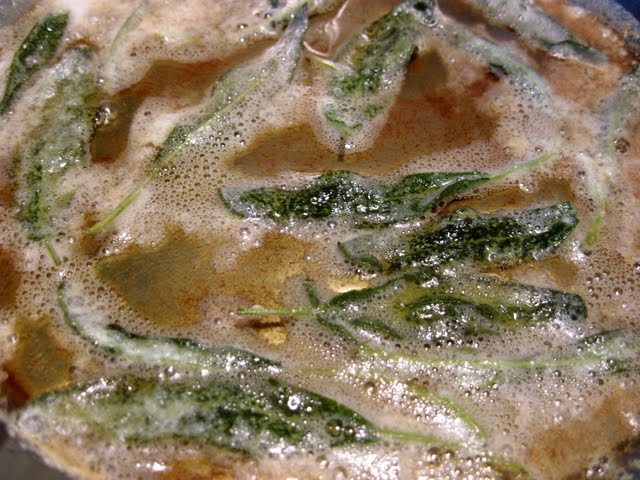
Once the sage leaves have become brownish and brittle in butter, I often remove them before the cream makes them soggy. These crispy, butter-soaked leaves are hard not to devour on the spot, but I like to sprinkle them as a flavorful garnish.

Sunday, June 12, 2011

Roasted Bell Pepper Obsession

Sometimes I cook a dish not to feed or for a subtle balance of flavors, but out of single-minded, monistic, shameless, worshipful obsession. It works like this: I didn’t need four adjectives to describe this kind of obsession, especially not both of the first two. But to have more of one thing, I need a variety of sameness. How do I create more roasted bell pepper? By adding other things, flavors spinning around a center always just to the side of roasted bell pepper. The center is almost the sauce, everything bound together in cream. The other things are just drawn out aspects of the original: bacon smokey like them, smoked paprika essentially the same as them, but dried and powdered. Then there are those forgotten things: onions and garlic sauteed in olive oil. What metaphor to turn to (the search for which is itself a good metaphor for what it is to organize a dish around a single ingredient)? Melody, harmony, and rhythm?

1 pound tiny yellow, orange, and red bell peppers
1/4 pound bacon ends
1 smallish onion
4 cloves garlic
2 tablespoons olive oil
1 cup heavy cream
2 teaspoons smoked paprika
a pinch of black pepper
salt to taste

Chop onion and garlic finely. In a large saucepan on medium-low sautee onion and garlic in olive oil. Sprinkle with a pinch of salt. Stir every few minutes. Heat a large cast-iron skillet to medium heat. Cut tops off of bell peppers, slice in half, and de-seed. Drop bacon ends into skillet, then bell pepper halves. Stir bell peppers when bottom sides blacken a bit. When bacon ends are a little charred, and majority of bell peppers are somewhere blackened, transfer into large saucepan with onion and garlic. Mix together and add smoked paprika and black pepper. Add heavy cream. Stir every few minutes while the sauce thickens. It should take maybe fifteen minutes to thicken. When it’s the right consistency to stick to pasta, add salt to taste.