Friday, December 31, 2010

Oh my buttons!


In The Mill on the Floss, Tom explains to Maggie why he will not be running away the next day.  “It’s the pudden,” he confides, “I know what the pudden’s to be--apricot roll-up--oh my buttons!”  I’ve never heard of a roll-up before except of course those strips of candied fruit puree that kids used to (do they still?) have in paper-bag lunches called “fruit roll-ups.”  I assume this is a pastry.  It sounds very appealing, but more appealing to a not especially wealthy nineteenth-century English family who only ever has such things on special occasions than to my contemporary palate.  Apricot roll-up, ever since I read that sentence, has taken on a vibrant and uncertain life in my imagination.  I keep thinking of the words nd of why Tom is oh-my-buttonsing about it.  Incommensurate images float unresolved in my mind.  How is it rolled up?  It is made from fresh, dried, or otherwise preserved apricots?  What kind of pastry dough are they rolled up in: pate brisee, pate sablee, puff pastry, yeasted dough, or something else?  What is apricot roll-up?  At this point a google search would not answer the question I’m trying to ask.  I don’t want to know what it was historically, what George Eliot may have been referring to.  Because I don’t know what it is I have begun to imagine something.  I want to know what that something is, and in what ways it might be brought into the world.

Or maybe, considering what I did recently bake, I don’t want to make it tangible at all, and I’m content letting it draw me toward baked semblances.  After making pear-ginger tarte tatin and sweet potato pie for Christmas, I still had some pie dough leftover in the fridge.  Thinking of apricot roll-up, I rolled the remaining dough into a roughly rectangular sheet, covered it in thin pear slices, sprinkled it with brown sugar, cinnamon, and nutmeg, rolled it up and baked it at 400 F.  Well, fifteen minutes in I became paranoid that it wouldn’t become properly crisp and turned it up to 425 F.  Also I tried to pucker the ends together to keep the juices from running out too much.  The juices did run out and burned to a black caramel at the bottom of the pan, but I liked it.  It was a roll-up.  The nice thing about a culinary fantasy defined by a single word with little semantic grounding is that it can be many things.

I was also pleased because this pear roll-up was made from things that just happened to be around.  Probably derived from the frugality endorsed by environmentalism and an ego-aspiration to quiet resourcefulness, this is also one of my foremost culinary desires.

Like the sweet potato pie of last entry, I liked it because of what I thought I was making as well as because it, I thought, tasted good.  Some vagueness or polyvalence in what I imagine I’m making seems to be a necessary part of this equation.  Taste is again mediated by fantasy, but instead of the enticing photos I referred to as enthralling (as in actually placing me in their thrall) motivators to make Mrs. Hudson’s Biscuits, tarte tatin, and apple strudel, this came of a written phrase.  Why do I romanticize the textual seed of this fantasy, and hold the photographic distastefully between thumb and pinky?


1 small round pate brisee
1 large pear
4 tablespoons brown sugar
1 1/2 teaspoons cinnamon
1/2 teaspoon nutmeg

Roll out pate brisee into a rectangle roughly twice as long as it is wide.  Halve and core pear.  Slice pear thinly.  Lay pear slices parallel to the shorter edge in two rows.  Sprinkle brown sugar, cinnamon, and nutmeg over pear slices.  Roll from short side to short side.  Pinch together the open ends of the roll.  Place roll in a baking pan with the seam facing up.  Bake at 425 F for about half an hour, or until the crust turns golden brown.

What I Really Eat

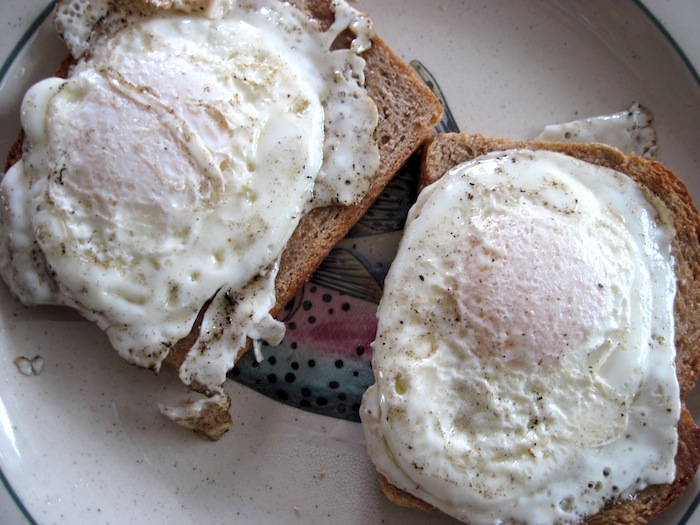
Eggs on toast and a cup of ginger tea is far too often
my breakfast.  Gosh, now that I'm writing about it,
it sounds nice.
Making gorgeous tarts and experimental sauces is all well and good, but what do you eat for lunch on a hectic day, for instance?  How about breakfast when your eyes seem to have retreated permanently into your skull?  What gets you through the days, presuming that nobody cooks for you and you haven't the money to go out?

I'm jobless, so my day-to-day food is still a little ambitious.  As in I might use the stove in addition to the microwave or the toaster.  No cooking at all is also a possibility, of course.  Recently for lunch I have been, rather than a dish per se, just throwing together three or four things that take a minimum of effort and not much time.  Most of the time this involves leftovers.

Mundane food would be strange to write recipes for.  It's creation is entirely circumstantial.  Unless you're the sort of person who plans all of your meals and meticulously buys only ingredients for use in your meals.  Personally I find life to be far messier, especially sharing food with who I live with.  Today my lunch was miso soup, a grilled cheese sandwich, and a pear.  Why?  Because miso, bread, cheese, and pears were around.  But someone else would have done something else with these same things.  My lunch was both circumstantial and idiomatic.  It would be silly to write a recipe because making these things is not particularly complicated nor desirable, and because they came out of a very particular situation.  Then again taking food in and out of different contexts is what recipes do.  Just because this context is not the pristine dream world of a culinary superstar and the food is not the subject of superlative praise does not make it pointless to share.  I guess.  Sharing is one thing, but a recipe?  Really?  Whatever.

The truth is, I didn't eat the pear.  It just sounded like what should have gone with it.

Monday, December 27, 2010

Taste


What makes a good tarte tatin? Going by the polite compliments of those who consumed the pear-ginger tarte tatin I made for Christmas dinner, my quibbles are excessive. Soggy crust does not matter. The way the butter rose to the top to form an off-white opacity does not matter. Hell, those things didn’t matter to me, either. I only wanted there to be more of it. Yet a sense of culinary aesthetics demands that the pears should not be laying in a pool of liquid when the tart is turned out onto a dish. (Maybe this could be avoided by using sugar instead of honey.)

There is also a sense that the making makes the dish, a conflation of the process with the result. The logic goes if I’m pleased with the pears boiling in honey--if it looks good, if it smells good--then the tart is good. This also goes for the sweet potato pie I made the same day. I liked its color (a bilious drab green), and what went into it. The light spices, the light sweetening of honey, the light color of the Japanese yam flesh, the thickness of the pie all came together in an aestheticism that had nothing to do with taste and yet constitutes a great part of taste. When I tasted it, it was the beauty of the process I was wishing for.

This is why it is necessary but impossible to separate taste from aesthetics, pleasure from ideas. Necessary because taste does not come of itself, and impossible for the same reason.

I might account for my former enthusiasm for the dozens of dense, eggy spice cakes by remembering my enjoyment of what went into them. There was a subtle balancing art of ingredients and spices that went into these cakes that was impossible to discern in the finished product unless you were me. It was possible for me to taste some hidden nobility in the cake despite the consistency which I could somehow deny. More likely I only now, several years later, remember them as dense and disgusting, and at the time there were not other possibilities that I knew of.

In honor of the cooking process’s interiority (if not the cook’s) rather than its ultimate appearance as taste to the world, the accompanying photos are of pear peels, pears boiling in honey, and unbaked sweet potato pie.

Excuse me.  Instead of "in honor of," the paragraph above should begin "to exploit," much like speeches that "honor" the dead.