Wouldn't it be cool if Himalayan blackberries really came from those mountains? Not really, but my brother and I have constructed a whole mythology around it. It's strung together with a kind of botanical personification: The Himalayan blackberry is so incredibly and invasively successful here because its native home is far harsher. Adapted to cold, cold winters and very little water, here it thrives. Like the Himalayas are a bramble boot-camp.

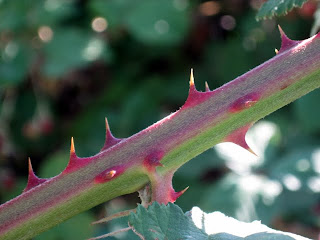
There is a certain logic to this. They are so at home here and so impossibly hardy that they must come from some otherworldly place, and the Himalayas are that to us, rising to elevations we have never visited and on the other side of the earth. There is something alien in the brambles' utter familiarity with the landscape. Nothing native could grow so well--nativity, after all, must be nurtured. These cannot be destroyed. They will come back year after year from dry slashed up root matter forgotten in the ground. Up my street there is a family who for three years chopped them down, pulled them up, burned them, and sprayed them. They still persisted.
 |
| This year's new canes where they were "removed" last year. |
My brother and I always laugh when a restoration project we're working on as
employees of my father involves pulling up blackberries and planting native plants in their place. We know it won't really work. It's amazing, really, the destruction that these plants excite in people like us. The same people who are melancholy about Arizona's immigration legislation happily engage in what amounts to a campaign of firebombing on an immigrant who was brought here more than 100 years ago. Last year there was a volunteer effort to remove what looks like a multiple acre swath of nothing but blackberries along Ashland Creek. It's doomed, of course, unless the same thing is done every year. This year the new canes have grown quite tall. If anything is clear to me, it's that Himalayan blackberries are here to stay.
But they are non-native and invasive, and thus the perfect scapegoat. We need them to be our punching bag. Without the millions of brown, slain blackberry canes, the native plants planted there would not be so proudly native. The category of native has been eked out through an extensive labor of killing Himalayan blackberries. And other species, sure, but mostly them.
But this is all hocus-pocus. To most of us, blackberries are blackberries. We do not know them as native and non, Pacific and Himalayan. They are simply that ubiquitous bramble that in the late summer bears purple berries. They are the landscape that they "invade."
Though I always wondered if perhaps they came from the lower, greener slopes of the Himalayas, I admit that I didn't know until just now that in fact, if we care to deal in fact, they have nothing to do with the Himalayas. Apparently, Luther Burbank, an American horticulturalist, visited India and there found some blackberry seeds in a market. He grew them, liked them, and decided to call them "Himalayan Giant." Wikipedia and others have pinned down the species' origin to Armenia,
someone going so far as to say that the only correct scientific name of the plant is Rubus
armeniacus Focke (much taxological confusion surrounds it, called by
several names: "R.
procerus Muller, R.
praecox Bertol., R.
grabowskii Weihe ex Gunther et al., or R.
discolor Weihe & Nees")
A gardening blogger went even further, stubbornly (like a teacher's pet) referring to them as "Armenian blackberries." It is undoubtedly true they are of the region of Armenia, but what of destiny? Who is to say that this plant wasn't meant for world domination any more than it was meant for Armenia? To go even further, and
really "naturalize" these things, who's to say it wasn't meant to be massacred?
It bleeds so deliciously. Well, alright, it really doesn't need to be injured or killed to yield its sweetness. Actually, more likely if you pick the berries
you will get pricked. Picking blackberries marks you; your hands become stained violet, berry juice sometimes mixed with a little blood. You come back scratched up but happy.
There are quite a few considerations involved in picking blackberries. The first is water: those bushes that grow near water or are irrigated (like near a grassy field) have fatter fruit. Personally, I prefer the places that provide shade, as picking in the late August weather is liable to kill you. My brother is a proponent of two things for serious picking: the two-by-six and the plastic gallon milk jug. The two-by-six (preferably salvaged from lumber scrap) is dropped on top of a productive but mostly inaccessible patch, and used as a platform from which to reach the berries nobody else could. The milk jug, the top 1/8 or so cut off with a knife, is the preferred berry-collecting device: it has a convenient handle, a large opening, and holds quite a lot.
Although my brother is now wary of the herbicides, diesel fuel, and god knows what else contaminating the soil near the railroad tracks, the tracks near the middle school used to be one of our favorite places to pick. I remember one day in late August when we drove there in his cream-colored Mercedes diesel (to run biodiesel, of course) as enormous slate walls of cloud grew above us. It was late in the day, and the light slanted yellow from a slit of unclouded horizon. The excessive details added up then to more than they do now: The four of us picked for an hour, until we were pelted with hail. It hurt, and we ran into the car with our various buckets (gallon milk jugs with the tops cut off, yogurt containers, paper bags, who knows what else) full of berries. Like a scene in an excessively nostalgic film, the fun bulged out a little nastily. The hail increased as we drove to the store, making more and more worrisome sounds on the steel roof. One of us (not me) used a newspaper to shelter himself on his way into the store to get oats, butter, and ice cream. Like all memories, it was mostly made up.

The object of all this youthful running about in a stormy idyll was blackberry crisp a la mode, of course, though we always called it cobbler. In fact "crisp" sounds wrong to me--it couldn't possibly refer to a baked dish of berries topped with (and sometimes lined with) a mixture of oats, butter, and brown sugar. We always made it that way because both my brother and my mother were allergic to wheat.
Baking a crisp was my goal when I picked today, but there weren't enough berries, and the hours of wandering around in the heat looking for enough berries exhausted me. So I will have fresh blackberries with various dairy products: ice cream, yogurt, (lightly) whipped cream. How terrible.
Fresh blackberries are yummy, but baking them in a crisp softens their flavor for good reason: The blackberry is a queer tasting fruit. It's not even clear it is one fruit. The same bush yields various tastes: bitter, sweet, gasoline-like, bland and mealy, moldy, almost always a little sour, and sometimes very sour. Sometimes you accidentally eat an ant, which has its own acrid, strangely complimentary taste.
Much in my life has revolved around blackberries. The first outing an ex (and now friend) and I had together was, I think, picking blackberries. One of my best childhood friends, who is no longer alive, used to eat red, unripe berries from the wall of brambles at the edge of the middle school. He had something to prove, I guess. One summer not too long ago (which probably means something like five years ago) my oldest friend and I made blackberry milkshakes. (Inevitably one of you is now laughing at your own joke: my milkshakes bring all the boys to the yard.) None of these memories are endemic to blackberries, because blackberries do not need endemicity. They pop up all over the place, given just enough water.


 )
)


