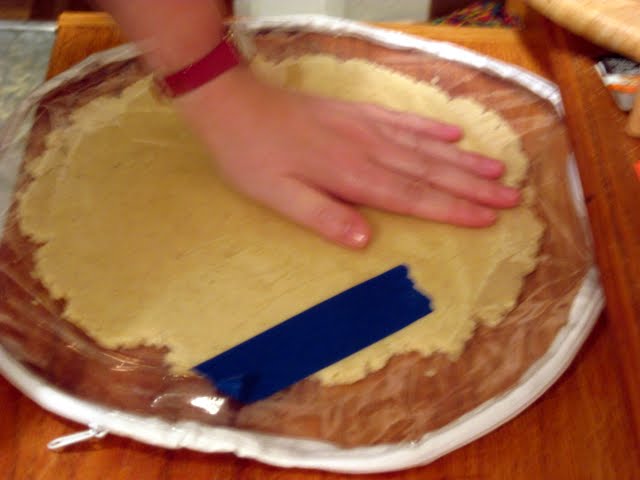
I suppose I should have photographed the whole process, showing you everything, plenty for your tactile imagination to chew on. But this isn't The Pioneer Woman Cooks! or some other shiny cooking blog. All I have are photos of the baked cookies themselves, which don't much illustrate the difficulty of making them. You can see the paraplegic cat, and a few other limbs broken off. This could've happened at one of a few points: transferring the cut dough shapes from the counter to the baking sheet, transferring the baked cookies off of the baking sheet, and simply handling the cookies to eat them. The package told us, like the chocolate chip cookie mix of the same brand, that the dough would seem dry, and that we needed to squish it together with our hands, and to roll it out between parchment paper and plastic wrap to 1/4 inch. How exactly did we do this without the dough crumbling to pieces? With difficulty. The package suggests using a cookie cutter. It does not suggest the acrobatics involved in getting the cut dough to the baking sheet. We carefully removed the layer around the shapes, trying not to break the shapes themselves, and used a spatula--quickly, quickly--to lift them in one piece (or, if the maneuver isn't executed perfectly, several). Irregular shapes with lots of limbs sticking off didn't fare well. The pumpkins were okay, being essentially a circle with a tiny bit sticking off (the stem).
I've never made shortbread cookies, regular or no, but what was the structural integrity these cookies were lacking? Gluten. I imagine regular (dare I call them that?) shortbread dough would stay together easily enough that it could handled with less care than nitroglycerin, and that the baked cookies would not be so delicate that they faint when they see a mouse. (Of course, when I saw a mouse in my kitchen at night I might've hit my head I jumped so violently.)
I complain, but the shortbread cookies were good, if messy, to eat. How can you go wrong with something that's mostly butter? The texture was a little grainy, becoming not quite the fine paste in the mouth that I'm used to from regular shortbread, but rich and a little sweet, as they should be. A nice tea biscuit.
Apparently, all legumes taste similar. Bob's Red Mill is partial to garbanzo bean flour in gluten-free baking mixes. Their chocolate chip cookie mix is mostly comprised of it, at which our noses twitched in mild disgust. Garbanzo beans and chocolate chips? Ew. Why not, say, oats? (The funny thing about gluten-free baking mixes is that each has a completely different approach to achieving the texture and flavor desired. Some are mostly rice, some oat, some garbanzo, some teff. Usually the actual ingredients are downplayed; the end result is everything. Which is odd these days, when every "organic" or "natural" product is busy bandying its ("simple," "pure") ingredients.) We didn't trust it, but we did already open the package, so what the hell. The cookies turned out beautifully, melting into the pan in folds of buttery chewiness (sorry, no photos). The flavor was unexpected, but not at all unpleasant. I devoured five in one sitting. I gave two to my brother, who when I asked him what kind he thought they were said "they're peanut-butter chocolate chip, right?"
Monday, August 22, 2011
Sunday, August 21, 2011
Gluten-Free Baking Part I: Simulation
I found myself making a strange conversational comment about gluten-free baking today: "Here," I said, "it's more of an experiment, whereas there it can be traditional." The over-there in question was Japan, because the owner of the recently opened Ichigo Cake, who is one of those male Niponophiles who is married to a Japanese woman, mentioned a type of rice-based chiffon cake made in Japan. There is a kind of hysterical traditionalism that the idea of gluten-free baking excdites in me at times. It's not just traditionalism, but a metaphysics of substance: No, I think, how is it bread if it isn't made from wheat?! The whole idea of gluten-free baking is heretical and challenging to this mindset. One tries to make something without the ingredients that have traditionally defined it. There is also the kind of gluten-free baking that adapts to the different qualities of other grain flours, making something entirely new and owning rather than trying to hide its uniqueness. But most gluten-free baking reaches toward realness: seeming indistinguishable from the gluten-based baked-good that it simulates.
It is because of how it resembles transexual politics that my knee-jerk reaction of "it's not real" seems so backwards. But there is of course a more visceral reason to defend gluten-free baking: for some, gluten really is poison. For my brother it's an allergen, something which makes him mucousy and plugged-up like he has a cold; it causes my girlfriend's immune system to go haywire, damaging her digestive system in its violent wake. (This is my dramatised picture of Celiac.) There are also, I hear, those who vow to go off wheat or gluten for health reasons, even though they have felt no ill effects. I find these people hard to disginguish from those who quaff wheat grass at juice bars. Children have the best neologisms: healthoholics.
When I said "experiment," i was thinking of a gluten-free bakery that's starting uncertainly in Phoenix (about five miles away), Gia's. The small, slapped-together storefront feels harried as you walk in. There isn't an employee at the counter, but a man with a walkie-talkie who I have a feeling is either related to or married to the baker. He communicates with the bakery itself across the parking lot, radioing that we're out of this or that, are you making more? This leads me to think that they have so little startup capital that they must reduce their risk by making tiny, on-demand batches and/or they just don't have the oven space to make enough at once to meet demand. Just opened a month ago, they're stilll figuring out how much of what customers will buy, and moreover are still probably gaining customers as the word of their existence spreads around those that want gluten-free. For the time being they'll just use what they've got. The cash register is a laptop hooked up to a receipt printer. The occasional cashier will come away from the bakery into the shop only when customers are afoot.
But as well as a business experiment, it's an experiment in baking. They're perfecting their recipes, looking for the right combination of flours and for the kinds of pastries people like. I am told the lemon bars are a hit. Personally I fell for the succulant carrot cake, which I didn't even realize was gluten-free until I felt the texture of rice flour in my second bite. My father had brought some home from the Talent Art Show (this is not some horrible exercise in naming--Talent is a town a few miles north of Ashland) where they were selling cupcakes as teasers for their bakery that was yet to open. There was chocolate and carrot cake. At least one of you is laughing at me, but I'm telling you, the carrot cake was far more tempting. At the time I didn't know its lusciousness (alas, there are only so many adjectives one can use to describe cake) was gluten-free; it was just some delicious cupcake from wherever. This, I suppose, is the simulationist gluten-free baker's dream. Gia's is exactly that. A recent Mail Tribune article says that "Jan Thorsell wants fellow sufferers of celiac disease to feel 'normal' when they walk into her new bakery." The normal customers also get to feel normal cake on their tongues.
Next, in Part II: a recent joint foray into gluten-free baking: chocolate-chip cookies and shortbread cookies.
It is because of how it resembles transexual politics that my knee-jerk reaction of "it's not real" seems so backwards. But there is of course a more visceral reason to defend gluten-free baking: for some, gluten really is poison. For my brother it's an allergen, something which makes him mucousy and plugged-up like he has a cold; it causes my girlfriend's immune system to go haywire, damaging her digestive system in its violent wake. (This is my dramatised picture of Celiac.) There are also, I hear, those who vow to go off wheat or gluten for health reasons, even though they have felt no ill effects. I find these people hard to disginguish from those who quaff wheat grass at juice bars. Children have the best neologisms: healthoholics.
When I said "experiment," i was thinking of a gluten-free bakery that's starting uncertainly in Phoenix (about five miles away), Gia's. The small, slapped-together storefront feels harried as you walk in. There isn't an employee at the counter, but a man with a walkie-talkie who I have a feeling is either related to or married to the baker. He communicates with the bakery itself across the parking lot, radioing that we're out of this or that, are you making more? This leads me to think that they have so little startup capital that they must reduce their risk by making tiny, on-demand batches and/or they just don't have the oven space to make enough at once to meet demand. Just opened a month ago, they're stilll figuring out how much of what customers will buy, and moreover are still probably gaining customers as the word of their existence spreads around those that want gluten-free. For the time being they'll just use what they've got. The cash register is a laptop hooked up to a receipt printer. The occasional cashier will come away from the bakery into the shop only when customers are afoot.
But as well as a business experiment, it's an experiment in baking. They're perfecting their recipes, looking for the right combination of flours and for the kinds of pastries people like. I am told the lemon bars are a hit. Personally I fell for the succulant carrot cake, which I didn't even realize was gluten-free until I felt the texture of rice flour in my second bite. My father had brought some home from the Talent Art Show (this is not some horrible exercise in naming--Talent is a town a few miles north of Ashland) where they were selling cupcakes as teasers for their bakery that was yet to open. There was chocolate and carrot cake. At least one of you is laughing at me, but I'm telling you, the carrot cake was far more tempting. At the time I didn't know its lusciousness (alas, there are only so many adjectives one can use to describe cake) was gluten-free; it was just some delicious cupcake from wherever. This, I suppose, is the simulationist gluten-free baker's dream. Gia's is exactly that. A recent Mail Tribune article says that "Jan Thorsell wants fellow sufferers of celiac disease to feel 'normal' when they walk into her new bakery." The normal customers also get to feel normal cake on their tongues.
Next, in Part II: a recent joint foray into gluten-free baking: chocolate-chip cookies and shortbread cookies.
Labels:
baking,
gluten-free
Friday, August 12, 2011
Pizza
My father has decided that "they" call me "Isaac 'Pizza' Skibinski." Not without reason. I've made pizza three times in the past week.
In the summer I always seem to be drawn to making pizza, despite the fact that turning on the oven when it's ninety degrees outside seems absurd (or, alright, just environmentally insensitive). When it's not delivered to your door as the quintessential late-night food, baked (or rather fried) in "deep dish" swimming with grease, two-inches thick and covered in various kinds of meat, I think of pizza as a summer food. In part this is because I grow basil in the summer (for some reason I've never been one of those enterprising people who grows it in a little windowsill pot when it's too cold for it to survive outside). What is pizza without fresh basil? (Yes, I know, I'm stuck on this.) It's also simply because my image of pizza is a summery image: thin, brightly colored, light(ish), bathed in sunlight.
In other words, my love of fresh pizza is slightly sneaky nostalgia for Italy. Even though what I make bears little resemblance to the thin snack I devoured there, it is that which I long for by making these things, I admit. I know it's not cool any more to think of Europe as the gastronomical promised land (unless you're Elizabeth Gilbert), as it was in the 30s and 40s when M.F.K. Fisher was visiting and dreaming of France. Nor is it 1961. Nor am I Julia Child. But let's be honest: I have silly idyllic daydreams of European food. There is nourishment and there is nourishment. I create this delusion that I'm creating Europeanness for myself more via the combining of Mediterranean ingredients than any meticulous attention to technique or finished product. As long as it has the right stuff--tomato sauce, mozzarella, fresh basil, maybe olives--and sort of looks like I imagine it should, I am content.
Generally I put these ingredients atop thin slices of good bread (in Ashland that's hearty, sour New Sammy's Cowboy Bread or La Baguette's French Sourdough, which is so fluffy that it becomes rock-hard stale in two days), and throw it in a hot oven for fifteen or twenty minutes. Recently I've discovered that the Ashland Food Co-op makes pizza dough and sells it in plastic bags. I've been looking for exactly that ever since I left Bar Harbor, where the local bakery sold bags of the stuff as well as the supermarket, but only recently did I actually find it here (because god forbid I, you know, ask). If I were one of the bazillion mothers who blog about what they feed their families, I would say that I have found a relatively quick and easy way to make pizza "from scratch," and wink as if I'm passing on some scandalous corner-cutting secret.
I wish I could say that their fresh dough is immeasurably better than bread. While the flat bread that comes out of the oven is fresh, its texture is tame and crispy like a cracker, where the bread slices are chewy and crunchy. This could be because I haven't kneaded the dough; it hasn't been stretched into the pizzeria crust I'm wishing for. But it's hard enough squishing the dough into the right shape without kneading it at all. Should I be kneading it and tossing it? Is that the only way to get it to not bounce eagerly back into itself?
I think, however, there is a certain romance in my lazy pizza-crust-making process. I plop the blob of dough into the glass roasting pan (we lack a cookie sheet or anything else more appropriate at home), which has a little olive oil on it. I dust the top with some white flour to keep it from sticking to my hands, and mash it down with fingers and fists. Once it's relatively flat, I begin stretching instead of squishing, until it roughly fills the whole pan. When the oven reaches 475 degrees, I lather and arrange all the ingredients on top of the dough, and bake it.
In the summer I always seem to be drawn to making pizza, despite the fact that turning on the oven when it's ninety degrees outside seems absurd (or, alright, just environmentally insensitive). When it's not delivered to your door as the quintessential late-night food, baked (or rather fried) in "deep dish" swimming with grease, two-inches thick and covered in various kinds of meat, I think of pizza as a summer food. In part this is because I grow basil in the summer (for some reason I've never been one of those enterprising people who grows it in a little windowsill pot when it's too cold for it to survive outside). What is pizza without fresh basil? (Yes, I know, I'm stuck on this.) It's also simply because my image of pizza is a summery image: thin, brightly colored, light(ish), bathed in sunlight.
In other words, my love of fresh pizza is slightly sneaky nostalgia for Italy. Even though what I make bears little resemblance to the thin snack I devoured there, it is that which I long for by making these things, I admit. I know it's not cool any more to think of Europe as the gastronomical promised land (unless you're Elizabeth Gilbert), as it was in the 30s and 40s when M.F.K. Fisher was visiting and dreaming of France. Nor is it 1961. Nor am I Julia Child. But let's be honest: I have silly idyllic daydreams of European food. There is nourishment and there is nourishment. I create this delusion that I'm creating Europeanness for myself more via the combining of Mediterranean ingredients than any meticulous attention to technique or finished product. As long as it has the right stuff--tomato sauce, mozzarella, fresh basil, maybe olives--and sort of looks like I imagine it should, I am content.
Generally I put these ingredients atop thin slices of good bread (in Ashland that's hearty, sour New Sammy's Cowboy Bread or La Baguette's French Sourdough, which is so fluffy that it becomes rock-hard stale in two days), and throw it in a hot oven for fifteen or twenty minutes. Recently I've discovered that the Ashland Food Co-op makes pizza dough and sells it in plastic bags. I've been looking for exactly that ever since I left Bar Harbor, where the local bakery sold bags of the stuff as well as the supermarket, but only recently did I actually find it here (because god forbid I, you know, ask). If I were one of the bazillion mothers who blog about what they feed their families, I would say that I have found a relatively quick and easy way to make pizza "from scratch," and wink as if I'm passing on some scandalous corner-cutting secret.
I wish I could say that their fresh dough is immeasurably better than bread. While the flat bread that comes out of the oven is fresh, its texture is tame and crispy like a cracker, where the bread slices are chewy and crunchy. This could be because I haven't kneaded the dough; it hasn't been stretched into the pizzeria crust I'm wishing for. But it's hard enough squishing the dough into the right shape without kneading it at all. Should I be kneading it and tossing it? Is that the only way to get it to not bounce eagerly back into itself?
I think, however, there is a certain romance in my lazy pizza-crust-making process. I plop the blob of dough into the glass roasting pan (we lack a cookie sheet or anything else more appropriate at home), which has a little olive oil on it. I dust the top with some white flour to keep it from sticking to my hands, and mash it down with fingers and fists. Once it's relatively flat, I begin stretching instead of squishing, until it roughly fills the whole pan. When the oven reaches 475 degrees, I lather and arrange all the ingredients on top of the dough, and bake it.
Subscribe to:
Posts (Atom)


