I found myself making a strange conversational comment about gluten-free baking today: "Here," I said, "it's more of an experiment, whereas there it can be traditional." The over-there in question was Japan, because the owner of the recently opened Ichigo Cake, who is one of those male Niponophiles who is married to a Japanese woman, mentioned a type of rice-based chiffon cake made in Japan. There is a kind of hysterical traditionalism that the idea of gluten-free baking excdites in me at times. It's not just traditionalism, but a metaphysics of substance: No, I think, how is it bread if it isn't made from wheat?! The whole idea of gluten-free baking is heretical and challenging to this mindset. One tries to make something without the ingredients that have traditionally defined it. There is also the kind of gluten-free baking that adapts to the different qualities of other grain flours, making something entirely new and owning rather than trying to hide its uniqueness. But most gluten-free baking reaches toward realness: seeming indistinguishable from the gluten-based baked-good that it simulates.
It is because of how it resembles transexual politics that my knee-jerk reaction of "it's not real" seems so backwards. But there is of course a more visceral reason to defend gluten-free baking: for some, gluten really is poison. For my brother it's an allergen, something which makes him mucousy and plugged-up like he has a cold; it causes my girlfriend's immune system to go haywire, damaging her digestive system in its violent wake. (This is my dramatised picture of Celiac.) There are also, I hear, those who vow to go off wheat or gluten for health reasons, even though they have felt no ill effects. I find these people hard to disginguish from those who quaff wheat grass at juice bars. Children have the best neologisms: healthoholics.
When I said "experiment," i was thinking of a gluten-free bakery that's starting uncertainly in Phoenix (about five miles away), Gia's. The small, slapped-together storefront feels harried as you walk in. There isn't an employee at the counter, but a man with a walkie-talkie who I have a feeling is either related to or married to the baker. He communicates with the bakery itself across the parking lot, radioing that we're out of this or that, are you making more? This leads me to think that they have so little startup capital that they must reduce their risk by making tiny, on-demand batches and/or they just don't have the oven space to make enough at once to meet demand. Just opened a month ago, they're stilll figuring out how much of what customers will buy, and moreover are still probably gaining customers as the word of their existence spreads around those that want gluten-free. For the time being they'll just use what they've got. The cash register is a laptop hooked up to a receipt printer. The occasional cashier will come away from the bakery into the shop only when customers are afoot.
But as well as a business experiment, it's an experiment in baking. They're perfecting their recipes, looking for the right combination of flours and for the kinds of pastries people like. I am told the lemon bars are a hit. Personally I fell for the succulant carrot cake, which I didn't even realize was gluten-free until I felt the texture of rice flour in my second bite. My father had brought some home from the Talent Art Show (this is not some horrible exercise in naming--Talent is a town a few miles north of Ashland) where they were selling cupcakes as teasers for their bakery that was yet to open. There was chocolate and carrot cake. At least one of you is laughing at me, but I'm telling you, the carrot cake was far more tempting. At the time I didn't know its lusciousness (alas, there are only so many adjectives one can use to describe cake) was gluten-free; it was just some delicious cupcake from wherever. This, I suppose, is the simulationist gluten-free baker's dream. Gia's is exactly that. A recent Mail Tribune article says that "Jan Thorsell wants fellow sufferers of celiac disease to feel 'normal' when they walk into her new bakery." The normal customers also get to feel normal cake on their tongues.
Next, in Part II: a recent joint foray into gluten-free baking: chocolate-chip cookies and shortbread cookies.
Sunday, August 21, 2011

Friday, August 12, 2011
Pizza

In the summer I always seem to be drawn to making pizza, despite the fact that turning on the oven when it's ninety degrees outside seems absurd (or, alright, just environmentally insensitive). When it's not delivered to your door as the quintessential late-night food, baked (or rather fried) in "deep dish" swimming with grease, two-inches thick and covered in various kinds of meat, I think of pizza as a summer food. In part this is because I grow basil in the summer (for some reason I've never been one of those enterprising people who grows it in a little windowsill pot when it's too cold for it to survive outside). What is pizza without fresh basil? (Yes, I know, I'm stuck on this.) It's also simply because my image of pizza is a summery image: thin, brightly colored, light(ish), bathed in sunlight.


I wish I could say that their fresh dough is immeasurably better than bread. While the flat bread that comes out of the oven is fresh, its texture is tame and crispy like a cracker, where the bread slices are chewy and crunchy. This could be because I haven't kneaded the dough; it hasn't been stretched into the pizzeria crust I'm wishing for. But it's hard enough squishing the dough into the right shape without kneading it at all. Should I be kneading it and tossing it? Is that the only way to get it to not bounce eagerly back into itself?

Friday, August 5, 2011
Sage & Browned Butter
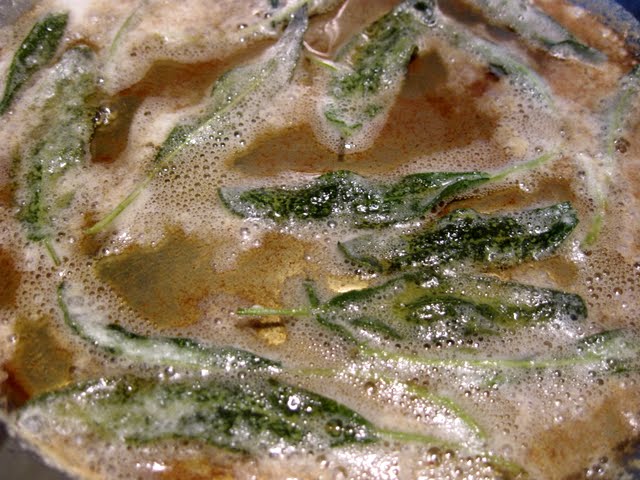
It was taken from two friends' repertoires, both of whom exalted it.
The one loved gnocchi more than the sauce she bathed them in, but aren't gnocchi a vehicle for sauce? She made gnocchi to bring decadence to our poorly deprived college lives of hippie lentil soup and mac n' cheese. The time-consuming and detailed labor of gnocchi were supposed to bring us out of the fraught, gaudy world of a small New England liberal arts school to somewhere more expansive. Like, say, Italy, after which she pined by kneading dough and smooshing it delicately with a fork.
But the sauce. Her method was to pour some cream into a saucepan with lots of fried sage leaves, simmer it down until it thickened into a sauce, and salt it to taste. This made a sumptuous covering for the pillowy lumps. As such rich sauces are bound to, it drew us all salivating in only to leave us for dead at the table, feeling sick and wanting to collapse into our half-finished plates.
The other was following a recipe for pumpkin ravioli with brown butter and sage, and was enamored, in her self-consciously understated way. She dropped sage leaves into melted butter and burned the butter just so. This is the base, and sometimes the whole, of every permutation of my sauce.
I have a kind of paranoid respect for the flavor of sage and browned butter. I don't think it should be messed with. Olive oil is, I feel, an evil addition to it. Other herbs, even black pepper, should be shunned from sage. Garlic is too much competition, and its cloying, under-your-fingernails savoryness clashes with sage's sharp scent.
The furthest I have strayed from the holy diad has been to incorporate bacon and finely chopped onions. This may have been too far.

Once the sage leaves have become brownish and brittle in butter, I often remove them before the cream makes them soggy. These crispy, butter-soaked leaves are hard not to devour on the spot, but I like to sprinkle them as a flavorful garnish.
Subscribe to:
Posts (Atom)